Tuesday, July 12, 2016

A Scientist's Journey to God

(13.76 MB)
I am a year(ish) away from earning my Ph.D. in neuroscience (the study of the brain, spinal cord, and peripheral nervous system). As I went through eight years of science education, many people have asked me: How do you stay close to God while being bombarded by all this science?
I think it’s important first to define what science really is. It is easy to want to avoid science if it seems like a collection of questionable “facts” assembled by scientists who are biased against God. But science is actually investigation: an organized, rigorous, and ongoing attempt to find truth. It is a process, not a corpus. Isaac Asimov, a biochemist and the author of the novel I, Robot, said: “Science doesn’t purvey absolute truth. Science is a mechanism. It’s a way of trying to improve your knowledge of nature. It’s a system for testing your thoughts against the universe and seeing whether they match. And this works, not just for the ordinary aspects of science, but for all of life.”
In addition to understanding that science is a process for discovery, I also started out with a critical belief: God’s Word is the foundation of all truth (John 17:17). Everything that I hear, everything that I learn, I compare to what God says. Without this starting point, my journey would have veered off course a long time ago. Albert Einstein said, “Science without religion is lame; religion without science is blind.”
Because I understand what science really is, and because I believe God’s Word is the foundation of truth, being a scientist does not hinder my relationship with God. My scientific journey has actually helped me grow closer to God in a few distinct ways.

I have learned to love and pursue truth

There is so much information available to us today, and in many cases no one is held accountable for whether what they say is true. It’s easy to find information that matches what I already think is right. It is easy to find information that makes up in emotion, bias and curiosity what it lacks in truth. But God expects more from me: “I say to you that for every idle word men may speak, they will give account of it in the day of judgment. For by your words you will be justified, and by your words you will be condemned” (Matthew 12:36-37). The scientific method has made me question whether I really love truth. Am I able to admit I was wrong when I find good evidence that refutes what I believe? Do I let my pride influence my opinions? It is very difficult to let go of a hypothesis or theory that I thought really made sense when I get results I don’t expect. But because science is a controlled process, it is a great mechanism for eliminating lies and false information. When my hypothesis is disproven, I must adjust my thinking. God takes this matter very seriously. Proverbs 19:5 says: “A false witness will not go unpunished, and he who speaks lies will not escape.”
I also need to use this same attitude in my spiritual life. Paul says, “[Love] does not rejoice in iniquity, but rejoices in the truth” (1 Corinthians 13:6). I cannot try to interpret God’s Word the way that I want it to go. I must be humble enough to seek God’s truth, even when it goes against what I think should be true. And I have found that the ongoing search for truth can be a challenging, exhilarating experience. It takes more work and is a very humbling process, but in the end brings godly love and peace.

I have learned humility

One of the reasons I decided to pursue neuroscience was because there is so much still to learn. We are nowhere near understanding how the human brain works–we’re still trying to figure out how the nervous system of a worm works . This is true in every crevice of creation. God made the physical world so wonderfully complicated that we will be studying it until Christ returns.
Here’s a short example: In the brain there are neurons (the main cells that talk to each other). They communicate with each other by sending chemicals or neurotransmitters (like calcium, dopamine, GABA) across synapses, which are little spaces between neurons. The neurotransmitters are sent and received through little molecular channels. Sounds simple, right? Except that for each neurotransmitter there are many different types of channels that respond in different ways based on the environment of the cell, other surrounding chemicals, the type of cells that are involved, etc. If we just focus on calcium, there are at many, many types of calcium channels, which open and close in different environments, deactivate at different times, and serve various purposes in different areas of cells. For each type of calcium channel, there are multiple subtypes of that channel. For each channel subtype, in each type of cell, scientists must isolate the channel and interrogate it (experimentally) to discover what properties it has, what its purpose is, and what happens when it doesn’t work properly. And that is all just for one tiny molecule. As I delve deeper into understanding God’s creation, it allows me to appreciate just how detailed, how organized, how beautiful God is.
With the physical world being this complicated, how much more amazing is the spirit world? We can’t even begin to comprehend it. Studying God’s physical creation helps me maintain an awe and reverence toward Him that is otherwise easy to lose. “Who is like You among the gods, O Lord? Who is like You, majestic in holiness, awesome in praises, working wonders!” (Exodus 15:11).

I have learned to deal with uncertainty

As I said before, the results we get from science experiments are far from indisputable facts. Instead, each result is a tiny piece in the puzzle that is our world. Each piece is likely, but not definitely true. That’s why we have statistics: to show how likely each result is to be true. This is the way our world works–our experiments, our measurements, even our senses aren’t perfect. There is always some amount of uncertainty–some amount of risk–that is incorporated into everything we do. As a scientist, I have come to accept this. We will never have all the answers, and we can never be completely sure of what we know. That is why God’s Word is so comforting and so critical. It is the one thing we have that we can truly be sure of. God didn’t provide us the answers to everything yet, but He gave us enough information so that we can have successful lives, so that we can grow in character, and so we can have hope for the future. “The peace of God, which surpasses all understanding, will guard your hearts and minds through Jesus Christ” (Philippians 4:7).

I have learned to widen my perspective

At the end of the book of Job, God asks: “Where were you when I laid the foundations of the earth?” (Job 38:4). And, “Who has put wisdom in the mind? Or who has given understanding to the heart (Job 38:36)?” It is easy to forget what a limited perspective humans have. Science allows us to expand our perspective a few orders of magnitude. We can now see cells and molecules and atoms , as well as galaxies in the universe . Science enables us to get a small glimpse of the way God sees the universe. And I like to think about the fact that God can see all these different views at once. He sees neurotransmitters flowing across the synapses in your brain; He sees the moons orbiting Saturn; He sees you.
The fact that science allows us to expand our perspective is important because it is so easy to get absorbed in one physical perspective and forget all the others. It is so easy to automatically question God when hard things happen in my life: “Why would God allow this to happen?” “How come God won’t just give me this one thing–I know it would be good for me.” It’s easy to forget how much bigger a view God has. He knows me better than I know myself (1 Kings 8:39) and He knows how everything works together (Job 38). Many times things that seem so clear aren’t true at all. Science shows us that.

I have learned to appreciate God’s power and creativity

The more I study God’s creation, the more I appreciate how much God loves diversity and creativity. He created millions of species for us to discover, to explore, to take care of. He created a seahorse the size of your fingernail ; He created cuttlefish skin that can camouflage both color and texture ; He created insects that can take over the minds of their hosts . God is involved in every little detail; the more I learn about His creation, the more I learn about Him. He is caring and thoughtful and perfect.
Paul expressed this beautifully: “For since the creation of the world His invisible attributes are clearly seen, being understood by the things that are made, even His eternal power and Godhead, so that they are without excuse” (Romans 1:20).
The English chemist and Nobel Prize winner Sir Cyril Herman Hinshelwood said, “[Science is] an imaginative adventure of the mind seeking truth in a world of mystery.”
Science isn’t a scary or inherently bad thing. God made the world, and for me, becoming a scientist has allowed me to grow in knowledge, character, humility, respect and creativity.

Answers From a Famous Ex-Atheist About God

 by Mario Seiglie  Estimated reading time: 13 minutes

 MP3 Audio(24.67 MB)
Imagine for a moment being one of the world’s foremost atheists. You’ve basked in the fame of academic circles for 50 years and have written more than 30 books, many of which are hailed as hallmarks of atheistic thought. You’re highly respected, honored as one of the world’s brightest minds.
Then, suddenly, you announce you have reversed course and now believe in God.
You can imagine the reaction from most of your colleagues and the secular press—mostly anger, scorn and a withering hail of criticism.
What made you sacrifice your reputation and good standing among many of your peers, knowing full well how unpopular your belief in God was going to be, especially in an increasingly secular and atheistic society?
“I now believe that the universe was brought into existence by an infinite Intelligence. I believe that this universe’s intricate laws manifest what scientists have called the Mind of God.”
It’s a fascinating story, and one that holds many valuable answers for young and old alike who have asked the most basic and most important question: Does God exist?
It’s not often that you can view this topic from the other side of the aisle—from one who had been a champion of atheistic thought and had based his life and teachings on the premise that God did not exist.
Who is this person? His name is Dr. Antony Flew, an Oxford professor who spent 50 years teaching philosophy and constructing clever arguments to support an atheistic point of view.
Why did he change his mind? And more importantly, why did he go public about his acceptance of God’s existence, knowing the damage to his reputation among his colleagues that would follow?
Prior to his death in 2010, Dr. Flew wrote a book in 2007 titled There Is a God: How the World’s Most Notorious Atheist Changed His Mind, explaining why he had reversed his long-held position and what had compelled him to admit he had been wrong. It’s not often that we see a premier philosopher who was an atheist explain why he changed his mind and came to believe in a divine Creator. His reasons are great answers to those who question God’s existence.

A principle to guide your life

In his book Dr. Flew mentioned that early in life, he came on a principle that would guide his career: Follow the evidence wherever it leads, no matter how unpopular that may be.
In his youth, he thought the evidence at that time backed an atheistic perspective, namely, that the scientific data and philosophical reasonings pointed more toward a belief that God did not exist.
Yet, he mentioned, from the 1980s on, the evidence started turning against atheism and toward a Creator God. He then had to reluctantly reassess his beliefs.
 “I now believe,” he came to admit, “that the universe was brought into existence by an infinite Intelligence. I believe that this universe’s intricate laws manifest what scientists have called the Mind of God. I believe that life and reproduction originate in a divine Source. Why do I believe this, given that I expounded and defended atheism for more than a half century? The short answer is this: this is the world picture, as I see it, that has emerged from modern science” ( There Is a God , p. 88, emphasis added throughout ).
In particular, he offered three lines of evidence that convincingly led him to his belief in God.

How did the laws of nature come to be?

The first of these has to do with the origin of the laws of nature.
Dr. Flew was quite candid about his former atheistic views on the laws of nature, which are the standard explanation against God’s existence. Yet he would later call this type of reasoning “the peculiar danger, the endemic evil, of dogmatic atheism” (p. 86).
This is the assumption that things in the universe exist as they are and should be accepted as such without much further thought. It had been his defense against any questions about the ultimate origins of what exists.
He noted: “Take such utterances as, ‘We should not ask for an explanation of how it is that the world exists; it is here and that’s all’ or ‘Since we cannot accept a transcendent source of life, we choose to believe the impossible: that life arose spontaneously by chance from matter’ or ‘The laws of physics are “lawless laws” that arise from the void—end of discussion.’ They look at first sight like rational arguments that have a special authority because they have a no-nonsense air about them. Of course, this is no more sign that they are either rational or arguments” (p. 87).
As the growing body of evidence in science and technology pointed increasingly to a more theistic explanation of the universe, he asserted that these standard atheistic explanations were becoming antiquated and untenable.
 “My departure from atheism was not occasioned by any new phenomenon or argument,” he said. “Over the last two decades, my whole framework of thought has been in a state of migration. This was a consequence of my continuing assessment of the evidence of nature. When I finally came to recognize the existence of a God, it was not a paradigm shift, because my paradigm remains, as Plato in his Republic scripted his Socrates to insist: ‘We must follow the argument wherever it leads’” (p. 89).
He admitted that the accumulation of the evidence in the last two decades now supported the existence of a Creator God, and he had the courage, personal integrity and humility to accept this conclusion—no matter how personally disagreeable it had been for him.
He mentioned that the evidence dealing with the laws of nature increasingly indicated a Superior Mind was operating at a cosmic level.
 “The leaders of science over the last hundred years,” he wrote, “along with some of today’s most influential scientists, have built a philosophically compelling vision of a rational universe that sprang from a divine Mind. As it happens, this is the particular view of the world that I now find the soundest philosophical explanation of a multitude of phenomena encountered by scientists and laypeople alike.
 “Three domains of scientific inquiry have been especially important for me … The first is the question that puzzled and continues to puzzle most reflective scientists: How did the laws of nature come to be?” (p. 91).
One of the most enigmatic aspects of the laws of nature is that these invisible forces act on matter and energy, but are not matter or energy themselves. For them to work, they had to be in place before matter and energy existed, and they are not tangible objects. To believe all these intricate laws that act in unison somehow appeared together at just the right time, with just the right force, without some organizing Intellect behind them, defies logic.
 “The important point,” Flew brought out, “is not merely that there are regularities in nature, but that these regularities are mathematically precise, universal, and ‘tied together.’ Einstein spoke of them as ‘reason incarnate.’ The question we should ask is how nature came packaged in this fashion. This is certainly the question that scientists from Newton to Einstein to Heisenberg have asked—and answered. Their answer was the Mind of God” (p. 96).
So, although it may not be well known, a number of cosmologists and physicists have admitted that the orderly laws of the universe point to something bigger and grander than the universe itself!
Flew quoted numerous of these scientists, like the famous cosmologist Paul Davies, who affirms: “Science is based on the assumption that the universe is thoroughly rational and logical at all levels. Atheists claim that the laws [of nature] exist reasonlessly and that the universe is ultimately absurd. As a scientist, I find this hard to accept. There must be an unchanging rational ground in which the logical, orderly nature of the universe is rooted” (p. 111).
Flew concluded: “Those scientists who point to the Mind of God do not merely advance a series of arguments or a process of syllogistic reasoning. Rather, they propound a vision of reality that emerges from the conceptual heart of modern science and imposes itself on the rational mind. It is a vision that I personally find compelling and irrefutable” (p. 112).

How did life originate from non-life?

Flew’s second line of evidence for a belief in God has to do with the great difference that exists between life and non-life.
 “When the mass media first reported the change in my view of the world,” he related, “I was quoted as saying that biologists’ investigation of DNA has shown, by the almost unbelievable complexity of the arrangements needed to produce life, that intelligence must have been involved.
 “I had previously written that there was room for a new argument to design in explaining the first emergence of living from nonliving matter—especially where this first living matter already possessed the capacity to reproduce itself genetically. I maintained that there was no satisfactory naturalistic explanation for such a phenomenon” (p. 123).
Pondering over this question, Flew came to the conclusion that a self-replicating living thing being produced by chance from non-life utterly defies all odds. Self-replication means that something has within itself the ability to copy components of its being and pass traits and the mechanism itself to future generations.
Indeed, that copy has to be so perfectly reproduced that it can perpetuate itself in turn, and yet it also has to carry an additional system that permits it to adapt to a changing environment to improve its chances of survival.
As a philosopher, Flew pointed out: “Most studies on the origin of life are carried out by scientists who rarely attend to the philosophical dimension of their findings. Philosophers, on the other hand, have said little on the nature and origin of life. The philosophical question that has not been answered in origin-of-life studies is this:How can a universe of mindless matter produce beings with intrinsic ends, self-replication capabilities, and ‘coded chemistry’? Here we are not dealing with biology, but an entirely different category of problem” (p. 124).
He came to see that scientists don’t have a satisfying answer to this question.
 “Carl Woese, a leader in origin-of-life studies,” he explained, “draws attention to the philosophically puzzling nature of this phenomenon. Writing in the journal RNA, he says, ‘The coding, mechanistic, and evolutionary facets of the problem now became separate issues. The idea that gene expression, like gene replication, was underlain by some fundamental physical principle was gone.’
 “Not only is there no underlying physical principle, but the very existence of a code is a mystery. ‘The coding rules (the dictionary of codon assignments) are known. Yet they provide no clue as to why the code exists and why the mechanism of translation is what it is.’
 “He frankly admits that we do not know anything about the origin of such a system. ‘The origins of translation, that is before it became a true decoding mechanism, are for now lost in the dimness of the past, and I don’t wish to … speculate on the origins of tRNA, tRNA charging systems or the genetic code’” (pp. 127-128).
Although there is an increasing body of knowledge about how DNA and RNA work, scientists still don’t have a clue about how all these coding systems originated, which Flew concluded do point to a Superior Intelligence at work. 
He asked: “So how do we account for the origin of life? The Nobel Prize-winning physiologist George Wald once famously argued that ‘we choose to believe the impossible; that life arose spontaneously by chance.’ In later years, he concluded that a preexisting mind, which he posits as the matrix of physical reality, composed a physical universe that breeds life … This, too, is my conclusion. The only satisfactory explanation for the origin of such ‘end-directed, self-replicating’ life as we see on earth is an infinitely intelligent Mind” (pp. 131-132).

Did something come from nothing?

Flew’s third line of evidence is the very existence of the universe.
In his early years, Flew believed that the universe had always existed, a popular belief at that time. If something had always been around, he reasoned, there was no need to bring up a Creator to explain it. But new scientific discoveries made him question this premise and whether something could come out of nothing.
 “In fact,” he related, “my two main antitheological books were both written long before either the development of the big-bang cosmology or the introduction of the fine-tuning argument from physical constants. But since the early 1980s, I had begun to reconsider. I confessed at that point that atheists have to be embarrassed by the contemporary cosmological consensus, for it seemed that the cosmologists were providing a scientific proof of what St. Thomas Aquinas contended could not be proved philosophically; namely, that the universe had a beginning.
 “When I first met the big-bang theory as an atheist, it seemed to me the theory made a big difference because it suggested that the universe had a beginning and that the first sentence in Genesis (‘In the beginning, God created the heavens and the earth’) was related to an event in the universe …
 “If there had been no reason to think the universe had a beginning, there would be no need to postulate something else that produced the whole thing. But the big-bang theory changed all that. If the universe had a beginning, it became entirely sensible, almost inevitable, to ask what produced this beginning. This radically altered the situation” (pp. 135-137).
Of course, atheists and secular scientists came up with counterarguments for the growing evidence for a universe with a beginning. Over the years all kinds of unlikely explanations have appeared.
 “Modern cosmologists,” he pointed out, “seemed just as disturbed as atheists about the potential theological implications of their work. Consequently, they devised influential escape routes that sought to preserve the nontheist status quo. These routes included the idea of the multiverse, numerous universes generated by endless vacuum fluctuation events, and Stephen Hawking’s notion of a self-contained universe” (p. 137).
Flew found all these arguments to be desperate attempts and quite unconvincing.
He concluded: “The three items of evidence we have considered in this volume—the laws of nature, life with its teleological [or purpose-exhibiting] organization, and the existence of the universe—can only be explained in the light of an Intelligence that explains both its own existence and that of the world. Such a discovery of the Divine does not come through experiments and equations, but through an understanding of the structures they unveil and map” (p. 155).
Thus the existence of a divine Creator is a certain fact of logic. As Scripture attests: “From the beginning, creation in its magnificence enlightens us to His nature. Creation itself makes His undying power and divine identity clear, even though they are invisible; and it voids the excuses and ignorant claims of these people [who would deny Him]” (Romans 1:20, The Voice).
Professor Flew died in 2010, but his intellectual and philosophical pursuit led him to accept the existence of an intelligent Creator—a surprising outcome for him, but one that was based on his lifelong premise that one should follow the evidence wherever it leads.
We hope his example, as well as the irrefutable evidence he was compelled to examine, will help others resolve the question of whether God exists. And by answering in the affirmative, it is the natural starting point for one’s journey of faith in developing arelationship with this awesome God who made us!

Monday, June 27, 2016

Daniel 9:26-27

9:26  “And after the sixty-two weeks an anointed one will be cut off and no one will come to his aid. Then the people of the coming prince will spoil the city and the sanctuary. But his end will come with a flood unto an end; a war is being decided; desolating things.”
9:27  “He will confirm a covenant with the great ones for one week. But in the middle of the week he will remove the sacrifice and the grain offering; and upon a wing of abominations he will be desolating, up to the point of a complete destruction being decided which will be poured out upon the one desolating.” 
Quite a few remarks need to be stated in regard to this passage. I will number them for the sake of making organized conversation points:
  1. As I noted in the previous post, these two verses focus entirely upon the events after the initial two periods of history (‘seven’ weeks and ‘sixty-two’ weeks). In other words, the final week of the Seventy Weeks prophecy gets the most attention, making its events the crux of the passage’s emphasis.
  2. The beginning of this passage moves the listener over a long period of time up to this decisive moment where an anointed figure will be killed. Since there is a massive sixty-two week period separating these events from those described in 9:25, it seems obvious that the anointed figure in 9:26 is not the same individual as the one back in 9:25. It has been common ground for Christians to regard this anointed figure again as the Anointed One (i.e., Jesus Christ). Again, this argument fails to hold up to scholarly scrutiny. For one, we again have the Hebrew noun mashiach without the definite article, requiring the translation “an anointed one” rather than “the anointed one.” Sadly, many modern English translations have not been entirely honest on this point. Secondly, if this were a predictive prophecy about the death of Jesus Christ, why does the passage qualify this death with “no one will come to his aid”? Shouldn’t the passage (if it were referring to the death of Jesus) say that he will be supernaturally vindicated in glorious resurrection by God the Father? Why then does the passage actually say that no one will come to his aid? This is hardly a reference to Jesus. Furthermore, the New Testament Christians (who searched the Hebrew Bible diligently for any hint of messianic predictions) never once quote Daniel 9:26 to refer to Jesus’ death. Instead, they focus primarily upon Isaiah 53 and other verses, but never once is Dan 9:26 quoted in the New Testament to refer to Jesus. This suggests that its interpretation had an accepted reading which excluded Jesus from being its object of focus.
  3. In fact, we possess a perfect candidate for this anointed figureonias 3mentioned in 9:26. In the year 171 BCE a high priest named Onias III was in fact murdered. Unfortunately for him, none of the Jews came to help him or avenge his death. Instead his brother, the Hellenistic sympathizer Jason, took control of the temple. The actions of Jason were instrumental in the events leading up to the Maccabean Revolt.
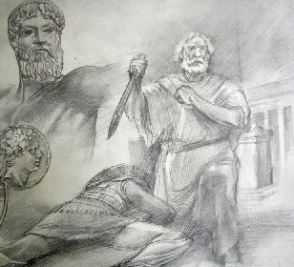
  4. Around this time, the Seleucid Empire ruled by Antiochus IV made an agreement with some of the leading officials in Jerusalem in order to hellenize the city and its people. This agreement is the “covenant” mentioned in Dan 9:27. This is recorded in detail in 1 Maccabees:
    In those days certain renegades came out from Israel and misled many, saying, “Let us go and make a covenant with the Gentiles around us, for since we separated from them many disasters have come upon us.” This proposal pleased them, and some of the people eagerly went to the king, who authorized them to observe the ordinances of the Gentiles. So they built a gymnasium in Jerusalem, according to Gentile custom, and they removed the marks of circumcision, and abandoned the holy covenant. They joined with the Gentiles and sold themselves to do evil. (1 Macc 1:11-15)
  5. After the murder of the anointed high priest Onias III the Seleucid armies, commanded by Antiochus Epiphanes, came into Jerusalem. The act of circumcision was restricted and the Sabbath was profaned. But the most detestable act was themacc placement of a statue of Zeus upon the temple’s sacrificial altar. Jews were forced to offer sacrifices to thisimage.These offensive acts are what Dan 9:26 refers to as the “spoiling of the city and the sanctuary” and what 9:27 describes as the plural “abominations.” These events were too much for the conservative Jews who were resistant to Hellenization (thus provoking the Maccabean Revolt).
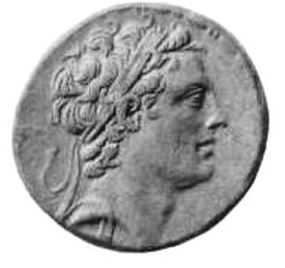
  6. As I just noted in #5, the Syrian forces led by Antiochus brought about desolating abominations upon Jerusalem and its people. Note carefully that these abominations of desolation are plural, not singular. Furthermore, they are plural objects, not persons. This is something different from what Jesus stated in Mark 13:14 (i.e., a single, personal abomination of desolation). This point should not be taken lightly; Daniel 9:24-27 refers to plural abominations as things/objects and Mark 13:14 refers to a single person who is an abomination of desolation. We should let Daniel 9 say what it wants to say and let Mark say something else (without harmonizing the two accounts). Jesus is likely reusing the terrible events of the past as a rubric to convey the future abomination of desolation.
  7. Daniel 9:26 promises that there will indeed be divine retribution upon the coming prince Antiochus. His end will come with a “flood” – a common propheticanti4hyperbole for a swift death (cf. Isa 8:8; 10:22; 30:28; Ezek 13:13; Nah 1:8). Furthermore, 9:27 says that a destruction has been decreed by God (divine passive). This reassures the original readers that this national catastrophe will not go unpunished by Israel’s God, encouraging them to resist the hellenizing influences in covenantal faithfulness. Antiochus IV did indeed die in the year 164 BCE.
  8. To connect some loose ends, it is important to remember that some of the significant dates need to be kept in the forefront of these discussions:
    • Onias III, the Jewish high priest, was murdered in171 BCE. This began the agreement/covenant (1 Macc 1:11-15) between the Seleucids and the leading Jews to hellenize Jerusalem and its people,
    • The Syrian forces led by Antiochus halted sacrifices and offerings by placing an idol of Zeus upon the altar. This occurred in 167 BCE,
    • The Maccabean Revolt ended in 164 with the cleansing of the holy temple, thus removing all of the abominations from it,
    • 171 minus 164 equals 7. How many years are in a single week? Seven. When did the sacrifice and offerings cease? In the middle of this period (167 BCE).
  9. If the seventieth week deals with the events from 171-164 BCE, then prophetic schemes expecting a future seven year tribulation prior to the end of the age have absolutely no biblical basis for their theology.

Monday, May 30, 2016

That Prophet

That Prophet

John the Baptist, the one who Jesus said: Matthew 11: 9  But what went you out for to see? A prophet? yea, I say unto you, and more than a prophet. For this is he, of whom it is written, Behold, I send my messenger before your face, who shall prepare your way before you. Verily I say unto you, among them that are born of women there has not risen a greater than John the Baptist:

What an amazing statement!

Now we see where John is asked:

John 1:21: And they asked him: What then? Are you Elijah? And he said I am not. Are you the prophet? And he answered, No.

They were asking him if he were THE PROPHET mentioned by Moses in Deuteronomy 18:15: Yehowah your God will raise up unto you A PROPHET from the midst of you, of your brethren, LIKE UNTO ME; unto him ye shall hearken;

Deuteronomy 18:18: I will raise them up A PROPHET from among their brethren, LIKE UNTO YOU; and I will put MY WORDS IN HIS MOUTH, AND HE SHALL SPEAK UNTO THEM ALL THAT I SHALL COMMAND HIM. SO WHO WAS THE PROPHET LIKE UNTO MOSES FROM THE MIDST OF ISRAEL, OF YOUR BRETHREN?

Notice: Peter speaking to the people of Israel.

Acts 3:22-23: Moses indeed said, A PROPHET shall the Lord - YHVH God raise up unto you from among your brethren, LIKE UNTO ME. To him shall you hearken in all things whatsoever he shall speak unto you. AND, IT SHALL BE, THAT EVERY SOUL THAT SHALL NOT HARKEN TO THAT PROPHET, SHALL BE UTTERLY DESTROYED FROM AMONG THE PEOPLE.

Stephen speaking to the Hellenic Jews:

Acts 7:37: This is that Moses, which said unto the children of Israel, A PROPHET shall the Lord – YHVH your God raise up unto you of your brethren LIKE UNTO ME; him shall you hear – a command.

We understand from these scriptures that THE PROPHET LIKE UNTO MOSES IS JESUS GOD’S ANOINTED ONE.
We know that THE PROPHET LIKE UNTO MOSES WILL SPEAK THE WORDS THAT GOD PUTS IN HIS MOUTH TO SPEAK TO THE PEOPLE OF ISRAEL, and so Jesus says:

John 12:49-50: For I SPOKE NOT FROM MYSELF; BUT THE FATHER THAT SENT ME, HE HAS GIVEN ME A COMMANDMENT WHAT IS SHOULD SAY AND WHAT I SHOULD SPEAK. And I know that His commandment is life eternal: THE THINGS THEREFORE WHICH I SPEAK, EVEN AS THE FATHER HAS SAID UNTO ME, SO SPEAK I.

John 14:10: Believe you not that I am in the Father and the Father in me? THE WORDS THAT I SAY UNTO YOU I SPEAK NOT FROM MYSELF: but the Father abiding in me does His works.

John 14:24: He that loves me not keep not MY WORDS: and THE WORD WHICH YOU HEAR IS NOT MINE, BUT THE FATHER’S WHO SENT – COMMISSIONED ME.

John 17:14:  I HAVE GIVEN THEM YOUR WORD; and the world hated them, because they are not of the world, even as I am not of the world.

John 17:17: Sanctify them in the truth: YOUR WORD IS TRUTH.

John 17:20: Neither for these only do I pray, but for them also that believe on me through THEIR WORD;

John 5:24:  Verily, verily, I say unto you, HE THAT HEARS MY WORD, and believes Him that sent me, has eternal life, and comes not into judgment, but has passed out of death into life.

John 8:51: Verily, verily, I say unto you, IF A MAN KEEP MY WORD, HE SHALL NEVER SEE DEATH.

John 14:23: Jesus answered and said unto him, IF A MAN LOVE ME, HE WILL KEEP MY WORD: and my Father will love him, and we will come unto him, and make our abode with him.

Now we can conclude from what is written above that when Jesus was speaking to Israel during his 3 ½ year ministry he was speaking forth the words his God and Father gave him to speak to Israel and later through his disciples and follower they preached his message to the world.

Now, the vital question is: What words did God give to Jesus to give to Israel?

Jesus begins his message by using these words:

Matthew 4: 23: And Jesus went about all Galilee, teaching in their synagogues, and preaching the gospel – good news of the kingdom.....

The disciples ask him how to pray and he gives the following guideline:

Matthew 6:9-10:  After this manner therefore pray you: Our Father who is in heaven, Hallowed be Your name. Your kingdom come.

After giving God praise that very first thing the disciples are told to do is ask for God’s kingdom to come!

Jesus follows that up with this command to his disciples:

Matthew 6: 33: ... seek you first the kingdom of God, and His righteousness; ....

If we go through Matthew, Mark, Luke and John and later the writings of Paul we notice that the one topic spoken forth is a message about the kingdom of God and how to prepare to enter into that Kingdom!

So all the word that God gave unto His anointed one Jesus had to do with the message he preached about the coming Kingdom of God to this earth.

Why is this message so important to Jesus and his disciples and apostles?

Jesus said: John 6:63: It is the spirit that gives life; the flesh profits nothing: THE WORDS THAT I HAVE SPOKEN UNTO YOU ARE, SPIRIT AND ARE LIFE.

Jesus also said:

John 6:44: No man can come to me, except the Father that sent me draw him: and I will raise him up in the last day.

John 6: 65: ... he said, Therefore said I unto you, that no man can come unto me, except it was given unto him of my Father.

Now how does the Father draw a person to come to the lord Jesus?

Paul answers:

Romans 10:15: and how shall they preach, except they be sent? even as it is written, How beautiful are the feet of them that bring glad tidings of good things!

1 Corinthians 1:17: For Christ sent me not to baptize, but to preach the gospel: not in wisdom of words, lest the cross of Christ should be made void.

What gospel did Paul preach?

Acts 20: 24-25: But none of these things move me, neither count I my life dear unto myself, so that I might finish my course with joy, and the ministry, which I have received of the Lord Jesus, to testify THE GOSPEL OF THE GRACE OF GOD. And now, behold, I know that you all, among whom I have gone PREACHING THE KINGDOM OF GOD, shall see my face no more.

Acts 28:30-31: And Paul dwelt two whole years in his own hired house, and received all that came in unto him, PREACHING THE KINGDOM OF GOD, and teaching those things which concern the Lord Jesus Christ, with all confidence, no man forbidding him.

The things he taught concerning the lord Messiah Jesus would surely have been how he would return to establish the Kingdom of God on this earth and rule over the nations from Zion – Jerusalem.

So the message – words that Jesus spoke were words given to him by his God and Father to give to Israel and eventually to the world through his disciples, apostles and all his followers to the end of this age!

The words of that message give by Jesus are words that bring with them spirit and life to those who hear and accept the message as coming from the one whom God has sent.

Jesus said: John 6:63: It is the spirit that gives life; the flesh profits nothing: THE WORDS THAT I HAVE SPOKEN UNTO YOU ARE, SPIRIT AND ARE LIFE.

Jesus is now to those who will hear and obey his message of the good news of the Kingdom of God a life-giving spirit!

1 Corinthians 15:45: So also it is written, the first man Adam became a living soul. The last Adam became a life-giving spirit.

When we receive the words of the lord Jesus into our hearts and minds his life-giving spirit enters into us and we come to him as drawn by the Father, for the words that Jesus spoke were words given to him by his God and his Father and they are words that bring with them spirit and life!

Now we can see that the message that needs to be proclaimed to the nations, to all men and women on this earth is the message of the coming glorious Kingdom of God! It is through that message that God will draw people to His anointed one Jesus and lead them to trust in him and obey his words!

John 14:23: Jesus answered and said unto him, If a man love me, he will keep my word: and my Father will love him, and we will come unto him, and make our abode with him.

Luke 6: 47-48: Whosoever comes to me, and hears my sayings, and does them, I will show you to whom he is like: He is like a man which built an house, and dug deep, and laid the foundation on a rock: and when the flood arose, the stream beat vehemently upon that house, and could not shake it: for it was founded upon a rock.

We see here that hearing is followed by doing which means committed obedience to the words of Jesus. In doing this we shall live in the soon coming Kingdom of God and rule with him over the nations during his 1,000 years rule:

Revelation 1:6: and he made us to be a kingdom, to be priests unto his God and Father; to him be the glory and the dominion forever and ever. Amen.

Revelation 5:10: and made them to be unto our God a kingdom and priests; and they reign upon earth.

Revelation 20:6: Blessed and holy is he that has part in the first resurrection: over these the second death has no power; but they shall be priests of God and of Christ, and shall reign with him a thousand years.

What an amazing future is available to all who will hear and obey the words that God gave Jesus to give unto all those that are his! Amen, soon come lord Jesus.